
The number of people with symptoms of dementia seems to have increased dramatically over the past few years, and I understand some about the burden faced by their families, as I watched my mother care for my grandmother. However, I believe that some must be experiencing unimaginable hardships with various symptoms and under various circumstances. I’ve heard heartbreaking stories from friends who work as geriatric nurses, and from those who have gone to customers’ homes as plumbers and given me glimpses into the sloppy conditions of their homes! In addition, when young people in the prime of their working lives develop the disease, it tends to have a greater impact on their families and others around them than in the case of the elderly.
Like many diseases, dementia is considered a lifestyle disease rather than a genetic condition. People who develop dementia are less social, spend most of their time indoors, drink heavily and frequently. Also, they are not absorbing the nutrients they need. In addition, one of the key factors of cause is homocysteine. Homocysteine was mentioned in the last blog, and I would like to explain its role and prevention.
Homocysteine is an amino acid found in blood and is an intermediate product of the metabolism of methionine, an essential amino acid. This may be difficult to understand, so I will explain it with a diagram.
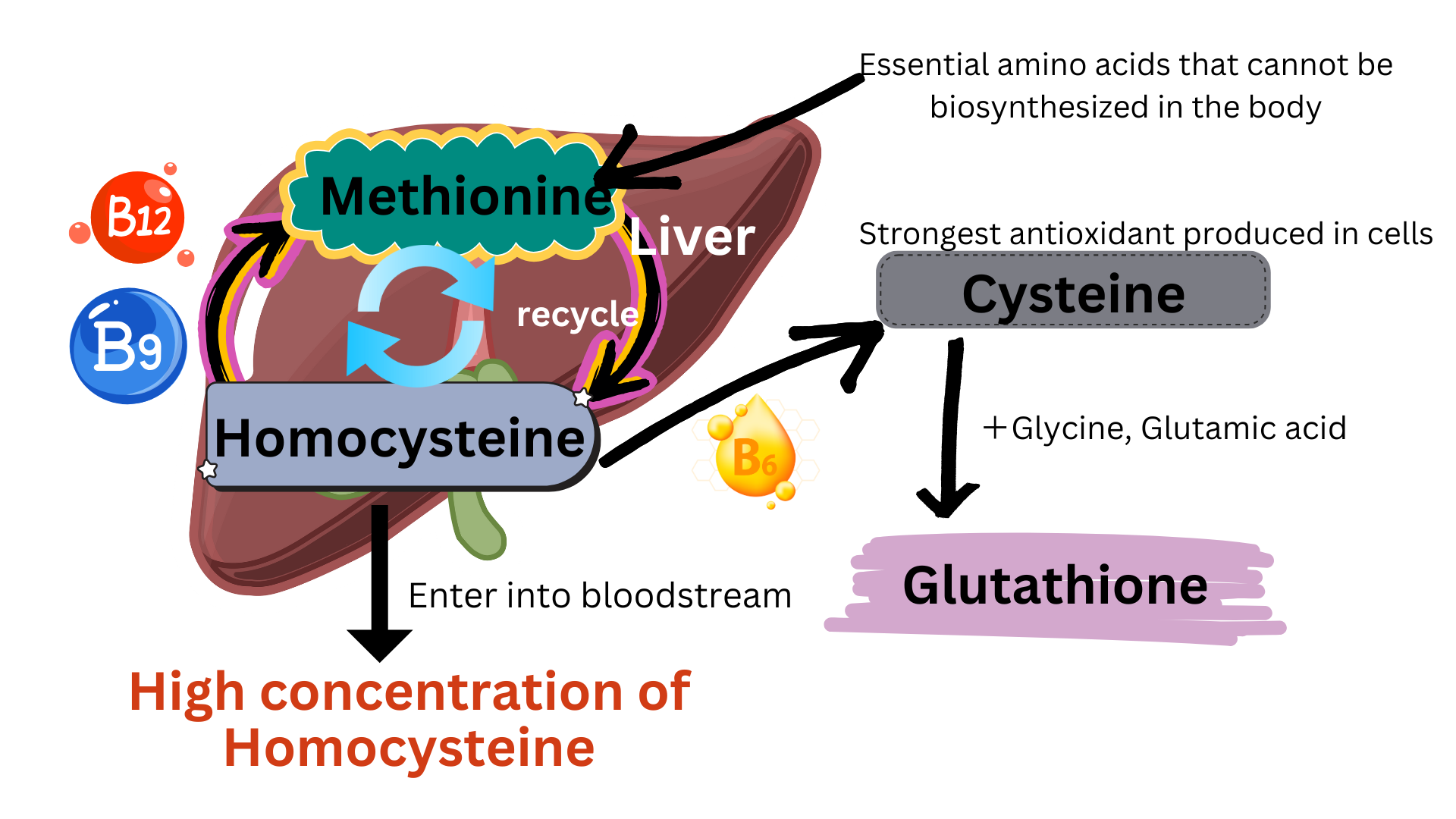
The human body needs 20 types of amino acids, of which essential amino acids are those that cannot be produced by the body and must therefore be obtained entirely from food. Proteins in food are digested in the gastrointestinal tract and absorbed as the smallest unit of amino acids. Amino acids are further broken down or reconstituted in the liver to make enzymes that are essential for the body’s cells and biological reactions.
One of these amino acids, methionine, can improve liver function and reduce blood levels of histamine, which can cause allergies. It is also the main raw material for enzymes that break down alcohol in the liver. When this methionine is metabolized, homocysteine is temporarily formed. Homocysteine is metabolized to methionine or cysteine and glutathione, but when the metabolic pathway becomes abnormal, the amount of homocysteine in the blood rises.
Homocysteine is created when methionine is recycled in the liver, and folic acid and vitamin B12 are needed to convert it back to methionine in the liver. Deficiency of these nutrients results in excess homocysteine because the conversion of homocysteine to methionine is blocked. The resulting condition that flows out of the liver into the bloodstream is hyperhomocysteinemia. Also, if vitamin B6 is deficient, homocysteine cannot be converted to glutathione via “cystathionine,” resulting in “hyperhomocysteinemia” as well.
Even if it does not lead to hyperhomocysteinemia, high homocysteine levels in the blood can damage the brain and blood vessels, making it easier to develop Alzheimer’s disease. It is also said to be a factor in cardiovascular disease and stroke, as I reported in last month’s blog. So I strongly suggest that you to check your homocysteine levels. Depending on the number, it may be a harbinger of dementia, or it may already be showing symptoms of dementia without being noticed.
While it is necessary to supplement this metabolic function with the necessary nutrients, if the liver itself is weak, it will not function properly no matter how much nutrition is provided. So it is important to keep your liver in good condition at the same time as supplementing with B vitamins. You may think that you are fine because your blood tests don’t show anything wrong, but do you really feel you are 100%? The liver fights hundreds of toxins, contaminants, and pathogens every day of the week, without rest, including pesticides, herbicides, fungicides, prescription drugs, aluminum, lead, copper, mercury, viruses, and bacteria. Prevent dementia by aiming to live a lifestyle that minimizes the burden on your liver. This is not only for yourself, but also for the loved ones around you.
Reference
https://pmc.ncbi.nlm.nih.gov/articles/PMC5836397/

 Your Body, Your Health, Your Life