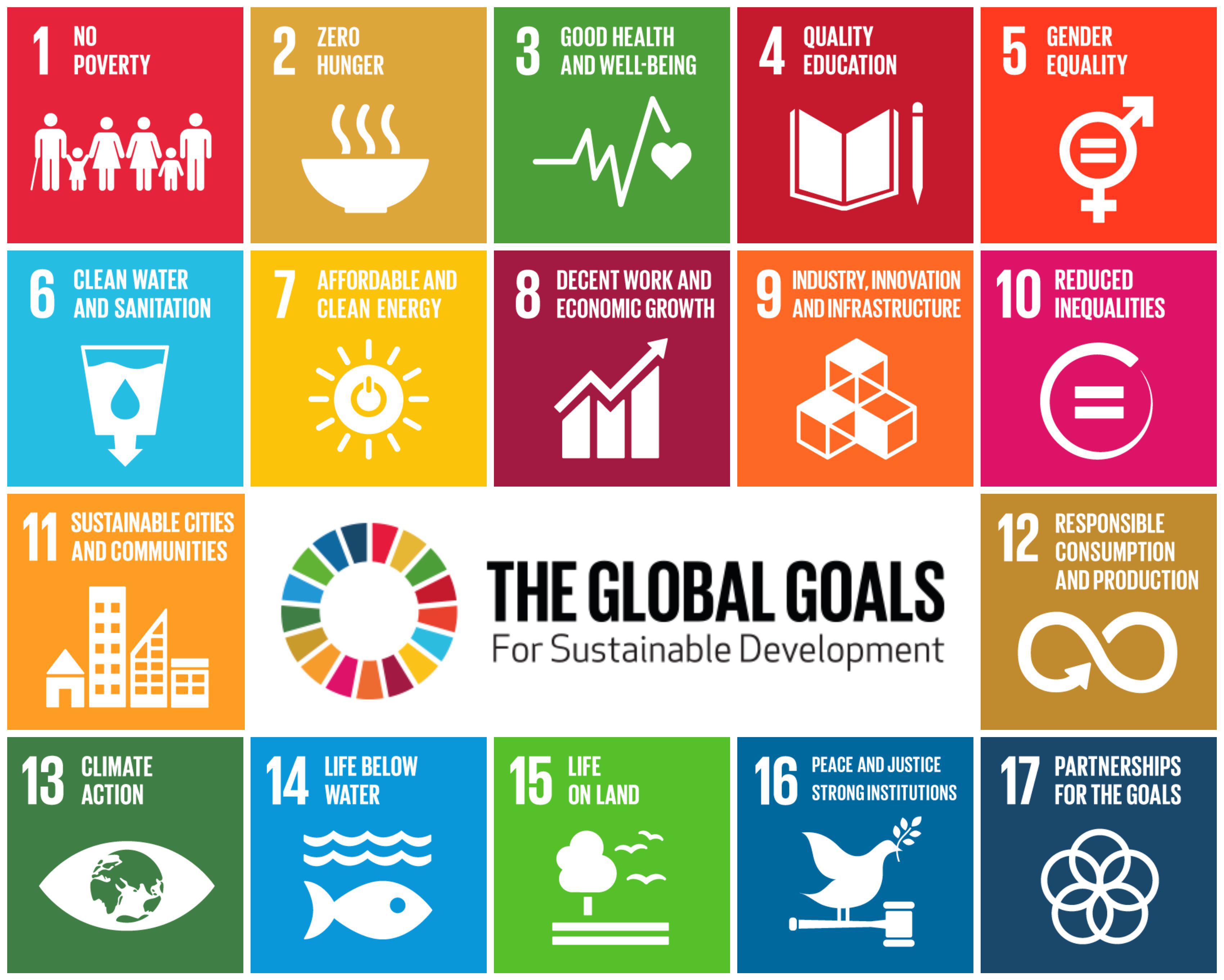
During my stay in Japan this year I was bothered that the term SDGs (Sustainable Development Goals) was frequently used on TV, in newspapers, magazines, and all other media. I don’t always follow what is going on in the world, and there are many things I don’t understand, but I intuitively think that the SDGs are a stinker. This is because the companies that openly support “to build a better future”, SDGs slogan, are mostly damaging the environment and/or human nature. Also, the media and the government seem to be dignifying it with “We’re doing good things!” Have you ever thought deeply about these SDGs? Are we (the public) the ones who will benefit when these “goals” are achieved?
To begin with, there are 17 goals, as shown in the photo above, and each of these goals has a target, and there are 169 targets! For example, Goal 1, “End Poverty,” includes targets such as “By 2030, end extreme poverty everywhere, currently defined as people living on less than $1.25 a day” and “By 2030, halve the proportion of men, women, and children of all ages living in poverty in all dimensions, as defined by country” However, no specific method or success stories are explained.
Do you know who created the SDGs? Yes, The United Nations. The U.N. is not a government and has no right to make binding laws. Instead, it uses the power of persuasion. So, there is absolutely no need to proceed with the measures as told by the UN!
The current critical environmental problems were caused by the Industrial Revolution. It can be said that instead of people gaining affluence and convenience, the environment was destroyed. Since the destruction of our environment has been identified as a serious issue that will affect our future generations, it is necessary to improve the situation and create a sustainable society. There are many articles and books that talk about things you can do for a more sustainable living/lifestyle. They are;
1, Avoid single-use water bottles instead, drink filtered tap water.
2. Reduce consumption of can/bottle drinks.
3. Reduce your consumption of meat.
4. Cook more at home to reduce food waste and food delivery.
5. Focus on “slow” fashion options.
6. Instead of driving a car, use a bicycle and/or more public transportation.
7. Reduce the amount you fly.
8. Grow your own vegetables and fruits.
9. Shop in person instead of being shipped.
10. Reduce packaging/wrapping (includes plastic wraps, aluminum foil, ziplocks, etc).
11. Reduce using paper towels, paper napkins, paper plates, and plastic utensils.
In addition to the above, appliances, cars, houses, buildings, machinery, tools, and other items used should be manufactured to last as long as possible. If you have to buy a new one every 5 years or so, that amount of waste will be created more frequently. Ultimately, “sustainable living” is possible by “buying less, using and consuming less, and throwing away less. This is an idea that goes against the capitalist economy, so companies and investors whose primary goal is to make a profit are doing something which sounds like they are supporting the SDGs, but the result will ultimately harm the environment.
Take solar panels, for example. Solar power, which is considered a reusable energy source, requires a lot of fossil fuels. Fossil fuels are used as carbon reductants to smelt metals from ore, as heat and power for the manufacturing process, and for transportation and deployment. Furthermore, almost 90% of the raw materials used to make solar panels end up in landfills because they are made of highly toxic chemicals that are difficult and costly to recycle. The buried land is creating the worst conditions for these toxic chemicals to accumulate.
Wind power is not exactly eco-friendly either. According to Harvard researchers, transitioning to wind power in the United States would require five to 20 times more land than previously thought, and such a large wind farm, if built, would raise the average temperature in the continental United States by 0.24 degrees Celsius.
Moreover, according to WWF, the major causes of deforestation and forest degradation are mass production agriculture and livestock. If we stop the production of mass-produced meat, soybeans, and corn used in processed, frozen, and fast foods, farmland will be transformed into forests and people’s health will be restored. But that is an impossible idea for capitalists. Furthermore, although electric vehicles are said to be eco-friendly, a large amount of fossil fuels are used to produce them and to build recharging facilities. Manhattan Institute physicist Mark Mills said in an interview with consumer journalist John Stossel, “If you’re worried about carbon dioxide, by the time an electric car gets to your doorstep, it’s emitting 10 to 20 tons of CO2 [from mining, manufacturing, and transportation].”Mills added, “Roughly speaking, to move energy from the gasoline to the electric sector, you would have to double the electric grid, and no one is thinking about doubling the grid.”
Thus, what major companies and investors announce to the public and what they actually do are at odds with each other. Think about it, goal 1 of the SDGs, “End Poverty,” will only make the rich richer in today’s capitalist society, and the poor will never disappear. Economist Richard Wolff says, “Capitalism comes with poverty.”
Are the SDGs goals that will make us happy? Or is it a policy masquerading as good intentions to bind us, take away our freedoms, squeeze us for money, and control us? I live in Brooklyn, where high-rise buildings, luxury apartments are expanding and small local stores are closing and capitalized chains are appearing. It is a world where there are vagrants pooping with their pants down next to high-end apartment that cost over $1 million for a small studio.
Reference:
https://www.thebalancemoney.com/what-is-the-united-nations-and-how-does-it-work-3306118
https://www.technologyreview.com/2021/08/19/1032215/solar-panels-recycling/
https://www.theguardian.com/environment/2020/feb/29/50-ways-to-green-up-your-life-save-the-planet
https://ourworldindata.org/fossil-fuels
https://sdgs.un.org/publications/sdg-good-practices-2020
https://spectrum.ieee.org/solar-energy-isnt-always-as-green-as-you-think
http://www.americanexperiment.org/solar-panels-produce-tons-of-toxic-waste-literally/
reason.com/2022/11/02/driving-electric-cars-produces-little-carbon-making-the batteries-produces-a-lot

 Your Body, Your Health, Your Life